AI
The AI Skills Gap in Singapore’s Financial Services: Why Technology Investment Alone Is Not Enough
Financial services organisations are investing in AI to improve productivity, accelerate information processing and support better decision-making. However, technology investment alone does not guarantee successful adoption.
23 Sept 2026
TL;DR
AI adoption is increasing across customer service, compliance, risk management, document processing and financial analysis.
However, many organisations lack employees who can apply AI effectively within finance-specific workflows.
In a 2026 survey, 46% of finance leaders identified AI and machine learning expertise as their most critical skills gap. Another 39% reported difficulty upskilling employees quickly enough to meet changing business demands.
Singapore’s recent finance hiring analysis also highlights demand for talent with FinTech, AI, data, cybersecurity and cloud capabilities.
For HR and AI implementation leaders, the priority is not simply to introduce more tools. It is to build practical capability, responsible-use habits and confidence across relevant roles.
The Skills Gap Is Becoming a Business Issue
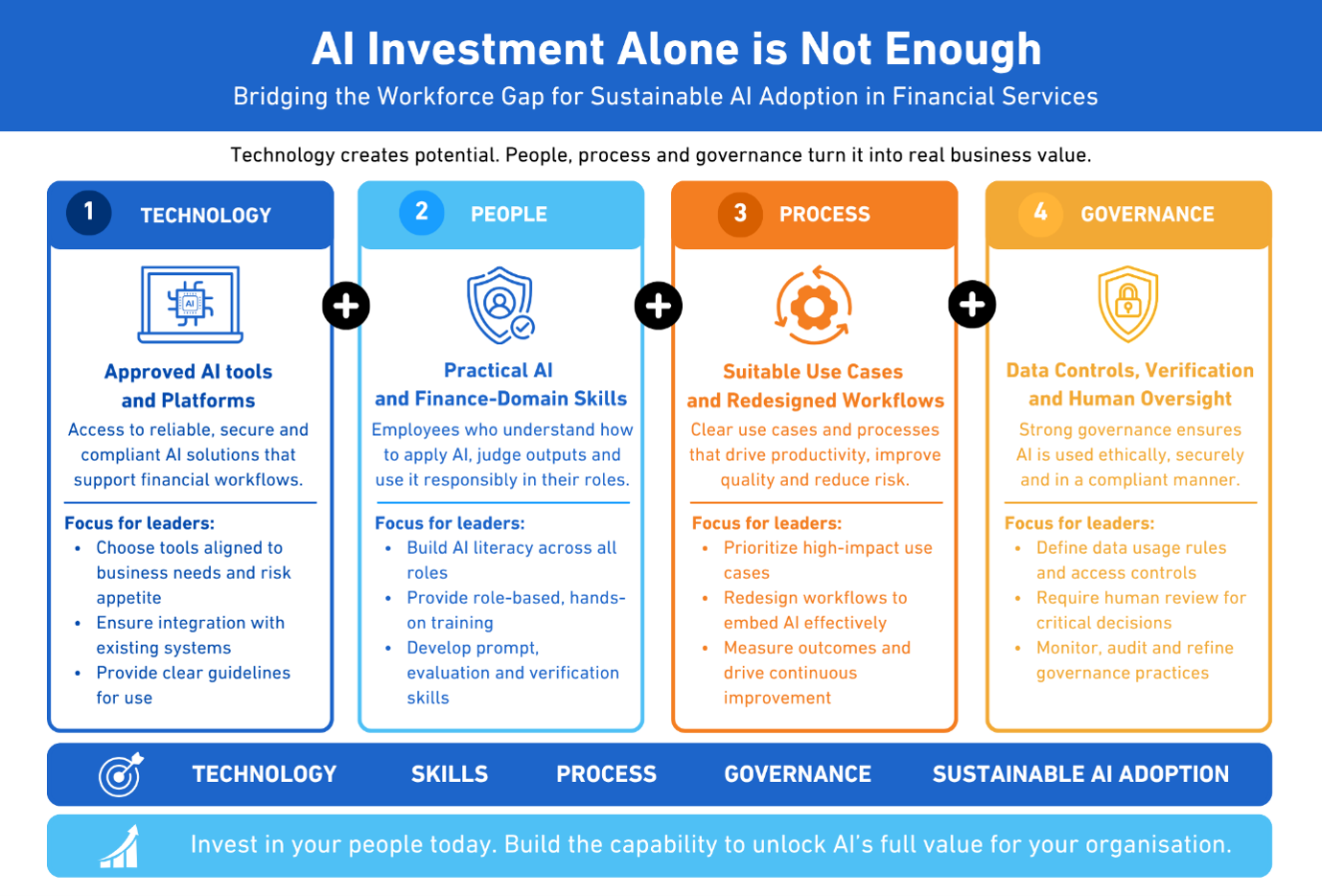
Financial services organisations are investing in AI to improve productivity, accelerate information processing and support better decision-making. However, technology investment alone does not guarantee successful adoption.
Employees need to understand how to apply AI to their daily responsibilities. They must also know when to verify an output, when human judgement is required and what information should not be entered into an AI platform.
A 2026 survey of finance leaders found that half of organisations had deployed AI only in selected departments. The survey also identified data governance, cybersecurity concerns and talent shortages as barriers to wider adoption.
Most notably:
46% identified AI and machine learning expertise as their most critical skills gap.
39% reported difficulty upskilling employees quickly enough to keep pace with changing business requirements.
The challenge is therefore not only whether an organisation has access to AI. The more important question is whether its workforce can use AI productively, securely and responsibly.
FinTech Is Increasing Competition for Specialist Skills
The skills shortage extends beyond traditional banking and insurance roles.
Recent Singapore finance hiring analysis highlights demand for professionals with experience in FinTech, AI, data, cybersecurity, cloud engineering, risk management and regulatory transformation. The analysis also notes that employers are becoming more selective and are placing greater value on specialist expertise.
Separately, a report on Singapore’s finance and insurance sector stated that 72% of employers had difficulty finding skilled workers.
This does not mean every finance professional needs to become an AI engineer or data scientist. It means financial institutions increasingly need employees who can combine strong domain knowledge with practical digital capabilities.
For HR and transformation leaders, this creates several workforce questions:
Which roles will be most affected by AI?
Which tasks can be improved through AI assistance?
What capabilities already exist within the organisation?
Where are the most urgent skills gaps?
Which employees require user training, implementation training or governance training?
How will the organisation measure whether training changes workplace behaviour?
These questions should be addressed before an organisation commits to large-scale tool deployment.
What the Skills Gap Looks Like in Practice
Larger financial institutions may have the resources to build internal AI academies, appoint specialist teams and redesign roles at scale.
Smaller banks, insurance agencies, financial advisory practices, brokerage firms, FinTech companies and boutique wealth-management businesses often operate with leaner teams. Employees in these organisations may handle several responsibilities within the same role.
A financial consultant may manage client relationships, conduct research, prepare proposals and complete regulatory documentation.
An insurance specialist may review policy terms, prepare quotations, process claims-related documents and respond to customer enquiries.
A compliance professional may need to examine policies, review regulatory materials, prepare internal updates and identify potential control gaps.
An operations employee may need to retrieve information from multiple documents, summarise cases and prepare reports for management.
AI can assist with many of these activities. However, productivity gains will remain limited if employees do not know how to structure prompts, assess the reliability of responses or apply AI within approved data-governance boundaries.
Without practical workforce capability, organisations risk paying for AI platforms that are used inconsistently or only for basic tasks.
The AI Skills Financial Professionals Need
The objective of AI training should not be to turn every employee into a technical specialist.
Most financial professionals require practical skills that can be applied within their existing roles.
1. AI literacy
Employees should understand what generative AI can and cannot do.
They should be familiar with common limitations, including inaccurate responses, incomplete context and outputs that appear confident but require further verification.
2. Prompting skills
Employees need to know how to provide clear instructions, relevant context and appropriate output requirements.
In financial services, prompting skills may be applied to:
Summarising reports
Drafting client communications
Comparing information across documents
Preparing initial research
Organising meeting notes
Creating first drafts of presentations
Generating questions for further analysis
3. Output evaluation
Employees should not treat AI-generated content as a final answer.
They need the judgement to check facts, identify missing information, review calculations and assess whether an output is suitable for a client, regulator or internal stakeholder.
4. Responsible AI use
Financial services organisations handle confidential and regulated information.
Employees therefore need clear guidance on:
What information may be entered into an AI platform
What information is restricted
Which approved tools should be used
When human review is compulsory
How AI-assisted work should be documented
Who is accountable for the final output
5. Finance-domain application
Generic AI knowledge is not enough.
Training should use examples connected to financial operations, insurance, advisory services, compliance, risk management, customer service and reporting. Employees are more likely to adopt AI when they can see how it applies to their actual responsibilities.
Matching Training to Different Workforce Groups
A single course is unlikely to meet the needs of every employee.
HR, L&D and AI implementation managers should consider at least three learning groups.
General business users
These employees need foundational AI literacy and practical productivity skills.
Relevant roles may include advisors, customer-service teams, insurance specialists, operations employees, administrative teams and employees who work mainly in Microsoft 365.
Training should focus on:
Understanding generative AI
Writing effective prompts
Summarising and drafting content
Verifying AI-generated outputs
Using AI within organisational policies
Managers and implementation leads
These employees need to understand how AI affects workflows, job design and team performance.
Training should focus on:
Identifying suitable use cases
Evaluating AI tools
Managing adoption
Redesigning workflows
Supporting employees through change
Monitoring business outcomes
Coordinating with IT, compliance and risk teams
Governance and senior leaders
These leaders are responsible for organisational accountability.
Training should focus on:
AI governance
Risk ownership
Responsible deployment
Regulatory considerations
Vendor evaluation
Data governance
Human oversight
Escalation and review processes
Segmenting training in this way helps organisations avoid two common problems: training that is too technical for general users and training that is too basic for implementation or governance leaders.
Relevant AI Learning Pathways
The appropriate starting point depends on the employee’s role and the organisation’s stage of AI adoption.
Microsoft Copilot for Business Productivity
Suitable for: Employees who regularly use Word, Excel, PowerPoint, Outlook and Teams.
Learning focus: Applying AI within familiar Microsoft 365 workflows, improving prompts, reviewing outputs and using Copilot responsibly.
ChatGPT for Business Productivity
Suitable for: Professionals who need support with research, drafting, analysis, idea development and scenario exploration.
Learning focus: Prompting techniques, output evaluation, source verification and responsible handling of organisational information.
CompTIA AI Essentials
Suitable for: Managers, team leaders and professionals involved in AI adoption or vendor discussions.
Learning focus: Vendor-neutral AI foundations, business applications, risks, governance principles and informed decision-making.
These pathways should be treated as complementary rather than interchangeable. The right mix will depend on workforce responsibilities, existing capability and the organisation’s AI maturity.
A Practical Workforce Readiness Checklist
HR and AI implementation leaders can use the following checklist to identify immediate gaps.
Leadership and ownership
AI capability development is included in the organisation’s workforce or transformation plan.
A named leader is responsible for AI workforce readiness.
HR, L&D, IT, compliance, risk and business teams have agreed on their respective responsibilities.
Leaders have identified priority business outcomes for AI adoption.
Workforce assessment
The organisation has identified roles that are likely to use AI frequently.
Current AI literacy has been assessed across different teams.
High-value tasks suitable for AI assistance have been identified.
Training needs have been segmented by role and responsibility.
Tool adoption
Employees know which AI tools are approved for business use.
Staff have been shown relevant use cases for their roles.
Employees understand how to evaluate and verify AI-generated outputs.
Adoption is measured through practical workplace outcomes, not only course attendance.
Data governance and responsible use
Clear guidance exists on what information may be entered into AI platforms.
Employees know when human review is required.
Client-facing AI-generated content goes through an appropriate review process.
AI policies are communicated in language employees can understand and apply.
Structured learning
General users receive practical AI literacy and productivity training.
Managers receive training on implementation, workflow redesign and change management.
Governance leaders receive training on responsible AI, accountability and risk.
Employees have opportunities to practise with finance-related use cases.
If several items remain unchecked, the organisation may not yet be ready to scale AI across multiple departments.
From Training Attendance to Workforce Capability
Course completion alone does not demonstrate AI readiness.
Organisations should look for evidence that employees can apply the learning in their work. Depending on the role, useful indicators may include:
Improved quality of prompts
More consistent verification of AI-generated content
Reduced time spent on repetitive drafting or summarisation
Better compliance with approved AI-use policies
Increased confidence in identifying appropriate use cases
More effective collaboration between business and technical teams
Fewer instances of inappropriate data being entered into AI tools
These indicators should be selected according to the organisation’s objectives. They should not be treated as universal performance measures.
The purpose is to determine whether training has improved workforce capability, not simply whether employees attended a course.
Singapore Support for AI Capability Development
The original research for this article identifies several Singapore initiatives relevant to organisational AI capability building, including the EDGE Grant, Champions of AI, the Enterprise Innovation Scheme and expanded AI learning initiatives for financial-sector professionals. Organisations should confirm current eligibility, qualifying activities and support levels directly with the relevant agencies before making funding decisions.
The ISCA and IMDA AIxAccountancy programme also demonstrates the growing emphasis on practical AI fluency for accountancy and corporate finance professionals. The programme was introduced to help professionals gain the skills and confidence to use AI effectively and responsibly.
Funding can reduce the cost of capability development, but it should not determine the training strategy.
The starting point should remain the organisation’s business objectives, workforce gaps, regulatory responsibilities and intended AI use cases.
The Priority Is Workforce Readiness
The financial services sector does not lack access to AI tools.
The more immediate challenge is ensuring that employees can use those tools effectively, responsibly and within the requirements of a regulated environment.
For HR managers, L&D leaders and AI implementation managers, the next step is not necessarily another technology purchase.
It is to assess:
Which roles require AI capability
Which skills are missing
Which use cases offer practical value
Which governance controls are required
Which learning pathway is appropriate for each workforce group
How improvement will be measured after training
The organisations that benefit most from AI will not necessarily be those with the most advanced tools.
They will be the organisations whose people know when, where and how to use them.
Recommended Next Step
Conduct a structured AI workforce-readiness assessment across relevant business teams.
If significant gaps are identified in AI literacy, practical application, implementation management or governance, consider a role-based learning pathway rather than a single generic course for the entire organisation.
ITEL’s corporate training team can support organisations in mapping suitable programmes to general users, implementation managers and governance leaders.
References
Asian Banking & Finance. (2026, February 26). Singapore finance firms struggle as 72% face talent gap.
Complete AI Training. (2026). Half of Singapore financial firms limit AI to select departments as talent and skills gaps persist.
Enterprise Singapore. (2026). Budget 2026: EDGE Grant, Champions of AI, and Enterprise Innovation Scheme.
FinTech News Singapore. (2026). AI reaches mainstream adoption in finance: Singapore leads in payment use cases.
Insurance Business Asia. (2025). Insurance sector leads as Singapore’s digital economy expands.
Institute of Singapore Chartered Accountants, & Infocomm Media Development Authority. (2026, July 3). AIxAccountancy: AI Fluency Programme for accountancy and corporate finance professionals.
Monetary Authority of Singapore. (2026, May 19). Keynote speech by Deputy Prime Minister Gan Kim Yong at the IBF Financial Industry Fiesta 2026.
Prime Minister’s Office Singapore. (2026, August 8). National Day Message 2026 by Prime Minister Lawrence Wong.
Singapore Global Network. (2026, June 24). Thinking about moving to Singapore for a finance role? Hiring trends to know in 2026.
To learn more about the IT industry, contact us today.
Contact usGet the latest news and insights and stay up-to-date with ITEL
Recent articles
Singapore's Corporate AI Skills Pathway
A Practical Framework for Building an AI-Ready Workforce
Read ArticleBeyond Automation: Why Workforce Capability is the Real Engine of Singapore's AI-Powered Logistics Boom
Explore how Singapore’s logistics industry is adopting AI and automation, and how workforce upskilling in AI, Power BI and workflow automation can drive smarter supply chains.
Read ArticleAIHGle 2.0 Singapore: What Healthcare Providers Need to Do Now
AIHGle 2.0 requires healthcare providers to strengthen AI governance, protect patient data, ensure human oversight, and build workforce capabilities for responsible, safe AI adoption.
Read Article