AI
AIHGle 2.0 Singapore: What Healthcare Providers Need to Do Now
AIHGle 2.0 requires healthcare providers to strengthen AI governance, protect patient data, ensure human oversight, and build workforce capabilities for responsible, safe AI adoption.
20 Aug 2026
Estimated Reading Time: 5, 6 Minutes
TL;DR
· AIHGle 2.0 updates Singapore's framework for responsible AI adoption in healthcare.
· Healthcare providers remain accountable for AI deployment and ongoing oversight.
· Clinical AI and Clinical Operations AI have different governance expectations.
· Together with the Health Information Act (HIA), AIHGle 2.0 strengthens AI governance, patient information protection and workforce capability.
Why AIHGle 2.0 Matters for Every Healthcare Provider
Artificial intelligence is rapidly becoming part of everyday healthcare delivery in Singapore. From AI-powered medical scribes and appointment scheduling to clinical decision support and diagnostic tools, AI is increasingly embedded in both clinical and operational workflows.
Since AIHGle 2.0 was introduced in March 2026, additional implementation guidance and FAQs have been released to help organisations operationalise the framework alongside the Health Information Act (HIA). The focus is no longer simply on adopting AI, but on deploying it safely, responsibly and with appropriate governance.
Understanding AIHGle 2.0 Accountability
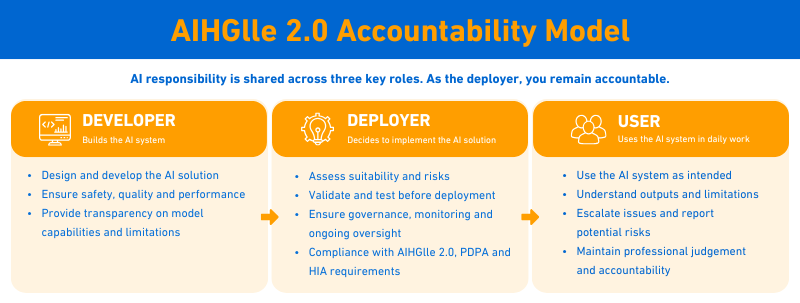
AIHGle 2.0 defines the responsibilities of Developers, Deployers and Users. Healthcare providers remain accountable for selecting appropriate AI solutions, monitoring performance, managing risks and maintaining governance throughout the AI lifecycle.
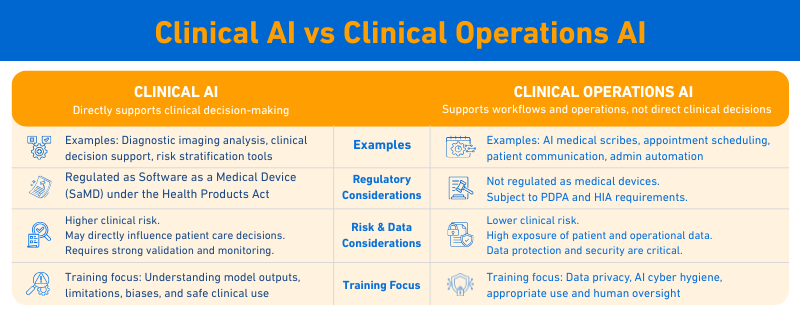
Clinical AI vs Clinical Operations AI
Clinical AI supports clinical decision-making and is generally regulated as Software as a Medical Device (SaMD). Clinical Operations AI supports administrative and operational workflows but still requires robust governance where patient information is processed.
How the Health Information Act Complements AIHGle 2.0
AIHGle 2.0 focuses on responsible AI deployment, while HIA governs the protection and management of health information. Recent implementation resources and FAQs help organisations translate these requirements into day-to-day operational practices, particularly when AI interacts with patient information or the NEHR.
AIHGle 2.0 Readiness Checklist
Before deploying or expanding the use of AI, organisations should review the following:
☐ Create an inventory of all AI tools currently in use, including department-level or trial deployments.
☐ Classify each solution as either Clinical AI or Clinical Operations AI.
☐ Determine whether the AI system accesses or processes NEHR-related information.
☐ Assign clear ownership for governance, monitoring, and oversight.
☐ Assess workforce capability and identify gaps in AI literacy, cybersecurity awareness, and data protection.
Core Work Capabilities
AIHGle 2.0 makes it clear that technology alone is not enough. Safe and effective AI adoption depends on a workforce that understands how AI should be used responsibly. Healthcare organisations should focus on three core capabilities.
Data Literacy
Employees should be able to interpret dashboards, understand AI-generated insights, and evaluate whether an AI tool is delivering meaningful operational or clinical value.
AI Security and Data Protection
Healthcare professionals should understand how to handle patient information securely, recognise AI-enabled phishing attempts, and minimise the risk of accidental data exposure.
Human Oversight
AI should support, not replace, professional judgement. Employees should understand when AI recommendations require further verification and know how to report unexpected or potentially unsafe AI behaviour.
Recommended Learning Pathways
Learning Pathway | Best For | Focus |
|---|---|---|
AI Implementation & Cybersecurity Hygiene | Practice Managers, Department Heads, IT Leads | AI security awareness, cyber hygiene, and understanding AI-related risks aligned with PDPA and HIA obligations |
Data Analytics & Dashboarding for Healthcare Leads | Clinical Directors, Practice Managers, Operations Leaders | Building data literacy, monitoring AI performance, and making evidence-based operational decisions |
Microsoft Copilot for Business Productivity | Administrative Teams, Operations Managers, Business Support Functions | Improving productivity through AI-assisted documentation, reporting, meeting summaries, and workflow automation |
Preparing your Organisation
Large healthcare institutions may have dedicated governance or compliance teams. Many clinics, laboratories and pharmacies do not. Preparing for AIHGle 2.0 is therefore less about creating new compliance departments and more about equipping employees with the knowledge and practical skills to use AI responsibly.
By investing in workforce capability, organisations can reduce operational risks, strengthen patient trust, and build confidence in the safe adoption of AI technologies.
AI Readiness Is Now Part of Healthcare Readiness
Meeting AIHGle 2.0 expectations is not only about selecting the right technology. It also requires employees who understand AI, know how to protect sensitive health information, and recognise when human judgement should take precedence.
Organisations that invest early in workforce capability, AI governance, and responsible AI adoption will be better positioned to deliver safe, trusted, and effective healthcare in an increasingly AI-enabled environment
References
· Ministry of Health – AIHGle 2.0 Circular (10 March 2026)
· Health Sciences Authority – Digital Health and AI in Healthcare
· Health Information Act Portal
· MOH HIA Implementation Guidance
To learn more about the IT industry, contact us today.
Contact usGet the latest news and insights and stay up-to-date with ITEL
Recent articles
Singapore's Corporate AI Skills Pathway
A Practical Framework for Building an AI-Ready Workforce
Read ArticleThe AI Skills Gap in Singapore’s Financial Services: Why Technology Investment Alone Is Not Enough
Financial services organisations are investing in AI to improve productivity, accelerate information processing and support better decision-making. However, technology investment alone does not guarantee successful adoption.
Read ArticleBeyond Automation: Why Workforce Capability is the Real Engine of Singapore's AI-Powered Logistics Boom
Explore how Singapore’s logistics industry is adopting AI and automation, and how workforce upskilling in AI, Power BI and workflow automation can drive smarter supply chains.
Read Article