Data Analytics, AI Automation
Beyond Automation: Why Workforce Capability is the Real Engine of Singapore's AI-Powered Logistics Boom
Explore how Singapore’s logistics industry is adopting AI and automation, and how workforce upskilling in AI, Power BI and workflow automation can drive smarter supply chains.
08 Sept 2026
TL;DR
• Singapore's logistics sector is accelerating its adoption of AI, automation, and digital technologies, creating demand for new workforce capabilities.
• The biggest challenge facing many logistics organizations is not technology adoption, but the ability of employees to translate data into operational decisions.
• Skills in AI, data analytics, business intelligence, workflow automation, and digital transformation are becoming increasingly valuable across logistics, warehousing, transportation, and supply chain functions.
• ITEL Learning Systems offers practical corporate training pathways to help logistics professionals build these future-ready capabilities.
Singapore's logistics sector is entering a new era of automation at scale. In August 2026, PSA announced that its automated Tuas Port had handled 25 million twenty-foot equivalent units (TEUs) since operations began in September 2022, demonstrating how digital technologies are already transforming logistics operations in Singapore (The Straits Times, 2026). Looking ahead, the Maritime and Port Authority of Singapore (MPA) envisions Tuas Port handling up to 65 million TEUs annually through advanced automation, electrified equipment, autonomous vehicles, and remotely managed operations (Maritime and Port Authority of Singapore, n.d.). As logistics operations become increasingly data-driven, organisations will need professionals equipped with AI, analytics, and automation capabilities to remain competitive.
Driven by national strategies such as Smart Nation 2.0 and supported by Singapore's Budget 2026 National AI Missions focusing on Connectivity & Logistics, the local logistics sector is expected to generate thousands of higher-value, technology-enabled roles. At the same time, Singapore's generative AI logistics market is projected to experience significant growth over the coming years, further increasing demand for digitally skilled professionals.
Yet, for many enterprise supply chain leaders, a paradox remains:
Why do investments in advanced ERP platforms, warehouse automation systems, AI solutions, and predictive analytics still fail to eliminate many day-to-day operational bottlenecks?
The answer often lies not in the technology itself, but in workforce capability.
According to the World Economic Forum, workforce skills gaps remain one of the most significant barriers to successful business transformation. While modern supply chains generate vast volumes of operational data across SAP systems, warehouse management systems (WMS), transport management systems (TMS), IoT sensors, and digital platforms, employees frequently lack the practical analytics, automation, and AI skills needed to convert data into business outcomes.
The Core Bottleneck: Moving from Descriptive to Predictive Operations
Most MNC logistics operations remain trapped in descriptive reporting—spending hundreds of manual hours pulling static spreadsheets to explain why a shipment was delayed, why inventory sat idle, or why fuel costs spiked last month.
To build supply chain resilience, organizations must shift to predictive orchestration and autonomous workflows.
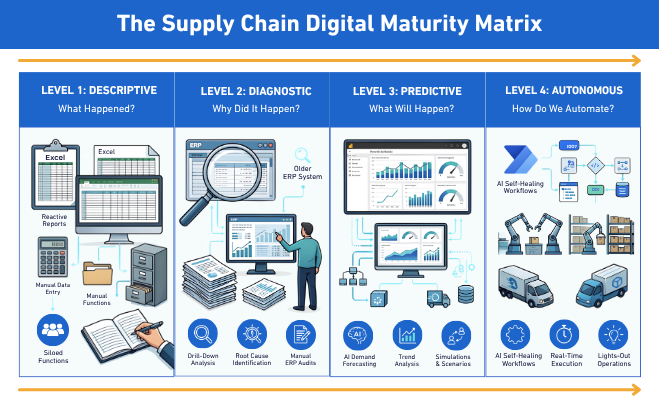
When operational teams transition across this maturity curve, daily firefighting gives way to proactive strategic planning. Achieving this level of maturity does not require hiring armies of specialized data scientists; it requires upskilling your existing business analysts, logistics managers, and procurement specialists (World Economic Forum, 2025).
Mapping AI Capabilities Across the Logistics Value Chain
To understand where workforce capability yields the highest return on investment, enterprise leaders must examine how AI and modern data analytics transform each segment of the logistics ecosystem.
1. Port & Terminal Operations
In high-throughput environments like Singapore's sea and air cargo terminals, vessel arrival variances and berth congestion directly impact downstream land transport schedules. AI applications now support real-time vessel arrival prediction, digital twin simulations, and dynamic crane scheduling (Maritime and Port Authority of Singapore, 2025). Operational leaders equipped with Predictive Analytics and interactive Power BI dashboards can synthesize complex telemetry, sensor data, and terminal analytics into clear executive decisions before congestion escalates.
2. Warehousing & Inventory Optimization
Modern distribution centers are rapidly adopting Autonomous Mobile Robots (AMRs), automated storage and retrieval systems (ASRS), and computer vision for stock audits. However, software alone cannot optimize cubic space utilization or dynamic slotting. Operations managers who master AI-assisted process improvement analytics can utilize predictive demand modeling to minimize warehouse handling touches and optimize stock replenishment thresholds dynamically.
3. Transportation & Fleet Management
Global route disruptions, changing fuel regulations, and carbon accounting mandates make fleet management increasingly complex. By utilizing Data Mining and Predictive Telemetry Analytics, transportation planning teams move beyond static GPS tracking. They project delivery windows based on live traffic patterns, optimize fuel consumption across clean-energy fleets, and trigger proactive vehicle maintenance alerts before breakdowns occur.
4. Enterprise ERP & Supply Chain Procurement
Enterprise ERP platforms such as SAP S/4HANA and Microsoft Dynamics 365 contain vast operational intelligence. Modern tools like SAP Business AI (Joule) and Microsoft Copilot enable procurement teams to automate contract intelligence, predict supplier risk profiles, and streamline purchase order approvals. Upskilling procurement staff in low-code workflow automation turns standard administrative processes into self-executing workflows.
Building Workforce Capability: The Missing Link in Digital Transformation
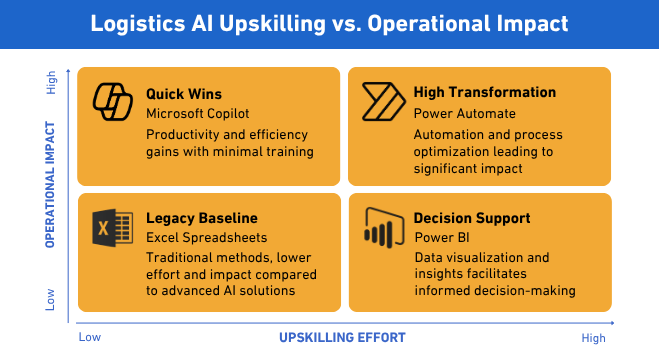
Installing enterprise tools like Microsoft Copilot or SAP Joule without targeted upskilling is like handing an advanced Formula 1 car to someone with a standard driver's license, the machine is powerful, but the operator cannot extract its full potential. Under Singapore's Budget 2026 "Champions of AI" initiative, government support is explicitly focusing on combining software adoption with structured workforce reskilling (Singapore Economic Development Board, 2026).
To bridge this capability gap, forward-thinking MNCs in Singapore focus on four foundational skill pillars:
Generative AI & Enterprise Productivity: Empowering non-technical business users to utilize natural language prompts for drafting procurement contracts, summarizing shipping compliance policies, and synthesizing multi-source data using tools like Microsoft Copilot.
Data Analytics & Visual Storytelling: Teaching logistics controllers and supply chain planners how to connect raw ERP data directly to Power BI, building automated visual dashboards that highlight inventory risks in real time.
Low-Code Process Automation: Enabling operations staff to build customized, automated approval workflows using Microsoft Power Automate, eliminating manual data entry between spreadsheets and enterprise software.
AI Strategy & Governance for Leaders: Training directors and senior managers to evaluate AI ROI, manage data security, and implement change management frameworks across global teams. As AI becomes more deeply embedded in business operations, organizations also need to understand the security challenges of AI adoption, particularly when AI systems interact with customer and business data.
Organizations that invest systematically in employee upskilling achieve faster tool adoption, reduce costly operational errors, and maximize the return on their digital transformation investments.
Transform Your Supply Chain Workforce with ITEL Learning Systems
At ITEL, we help enterprise organizations turn digital transformation strategies into practical workforce capabilities. As a dedicated IT and business upskilling partner in Singapore, our training programs are tailored specifically for operational leaders, data analysts, and supply chain managers looking to harness modern AI and data technologies.
Our enterprise course offerings include:
Microsoft Copilot & Generative AI for Business Productivity: Master AI-driven document creation, email management, and executive reporting.
Data Analytics & Power BI for Supply Chain Professionals: Transform legacy reporting into dynamic, real-time decision dashboards.
Microsoft Power Automate & Low-Code Workflow Design: Automate purchase order processing, inventory triggers, and operational reporting.
AI Strategy & Digital Transformation Leadership: Prepare enterprise leaders to govern, deploy, and scale AI tools across regional logistics hubs.
Supported by government funding schemes (such as SWDA grants for eligible Singaporeans and Permanent Residents), ITEL Learning Systems provides practical, hands-on learning paths designed to make your workforce AI-ready.
Is your workforce ready to lead the future of AI-driven logistics?
Contact the corporate learning team at ITEL Learning Systems today to customize an enterprise training roadmap for your organization.
To see how Singapore’s smart port infrastructure is driving automation across maritime operations, watch How Singapore Built Tuas Mega Port. This video provides a detailed look at how automated guided vehicles, digital twins, and AI control systems operate at scale in Singapore's newest trade hub.
References
Maritime and Port Authority of Singapore. (n.d.). Port of the future. Maritime and Port Authority of Singapore. Retrieved September 7, 2026, from Port of the Future
The Straits Times. (2026, August 6). PSA's automated Tuas Port hits 25 million TEUs amid $115 billion capacity race. The Straits Times.
Singapore Economic Development Board. (2026, March 24). Singapore's next growth chapter: What international businesses should know from Budget 2026. Government of Singapore. https://www.edb.gov.sg/en/business-insights/insights/singapores-next-growth-chapter-what-international-businesses-should-know-from-budget-2026.html
World Economic Forum. (2025, January 7). The future of jobs report 2025: Workforce strategies and AI transformation in supply chains. World Economic Forum. https://www.weforum.org/publications/the-future-of-jobs-report-2025/
To learn more about the IT industry, contact us today.
Contact usGet the latest news and insights and stay up-to-date with ITEL
Recent articles
Singapore's Corporate AI Skills Pathway
A Practical Framework for Building an AI-Ready Workforce
Read ArticleThe AI Skills Gap in Singapore’s Financial Services: Why Technology Investment Alone Is Not Enough
Financial services organisations are investing in AI to improve productivity, accelerate information processing and support better decision-making. However, technology investment alone does not guarantee successful adoption.
Read ArticleAIHGle 2.0 Singapore: What Healthcare Providers Need to Do Now
AIHGle 2.0 requires healthcare providers to strengthen AI governance, protect patient data, ensure human oversight, and build workforce capabilities for responsible, safe AI adoption.
Read Article