Singapore's Corporate AI Skills Pathway
A Practical Framework for Building an AI-Ready Workforce
08 Oct 2026
TL;DR
Most organisations buy AI tools before building workforce readiness, and that is why adoption stalls.
Sustainable AI adoption follows a five-level skills progression: from AI Foundations to AI Strategy & Leadership.
Sequencing matters: train leaders first to secure sponsorship, then build capability from the frontline upward.
Singapore's workforce initiatives support AI readiness, job redesign and practical upskilling.
Use the HR Readiness Checklist at the end to identify your organisation's priority gaps.
1. Tools Do Not Transform Organisations. People Do.
Many organisations have already invested in AI, whether through Microsoft Copilot, CompTIA AI Prompting Essentials or another AI enabled platform. Yet access to technology does not automatically lead to better results. Employees may try the tools, then return to familiar ways of working because they are unsure how AI fits into their roles.
What is often missing is a clear plan for building human capability alongside technology deployment. People need practical skills, guidance and confidence. Leaders also need to explain why AI matters, where it should be used and what responsible use looks like. Without this foundation, investment in AI can struggle to gain traction.
“Singapore’s AI workforce approach places people at the centre of transformation, with practical upskilling for both technical and non technical workers.”
IMDA, 2025
2. Most Organisations Are Training the Wrong People First
When organisations introduce AI training, they often begin with IT teams and technically confident early adopters. These groups are important, but they cannot create organisation wide change on their own. Leaders must understand the opportunities, risks and business priorities well enough to give employees clear direction.
Three in four Singapore employees surveyed were regularly using AI tools. Among these users, 85% said AI helped them save time, improve productivity or improve work quality. And more than two thirds of companies already using AI planned to prioritise training and upskilling for their existing workforce. (IMDA, 2025)
A more effective approach begins with leadership alignment, then builds the governance, implementation and workforce skills needed to support wider adoption.
3. The AI Workforce Readiness Ladder
The AI Workforce Readiness Ladder shows how capability can develop across five connected levels, from essential AI literacy to strategic leadership. Each level addresses a different group of employees, a practical set of skills and a clear organisational outcome. Employees do not necessarily need to progress through every level. The appropriate destination depends on their role and responsibilities.
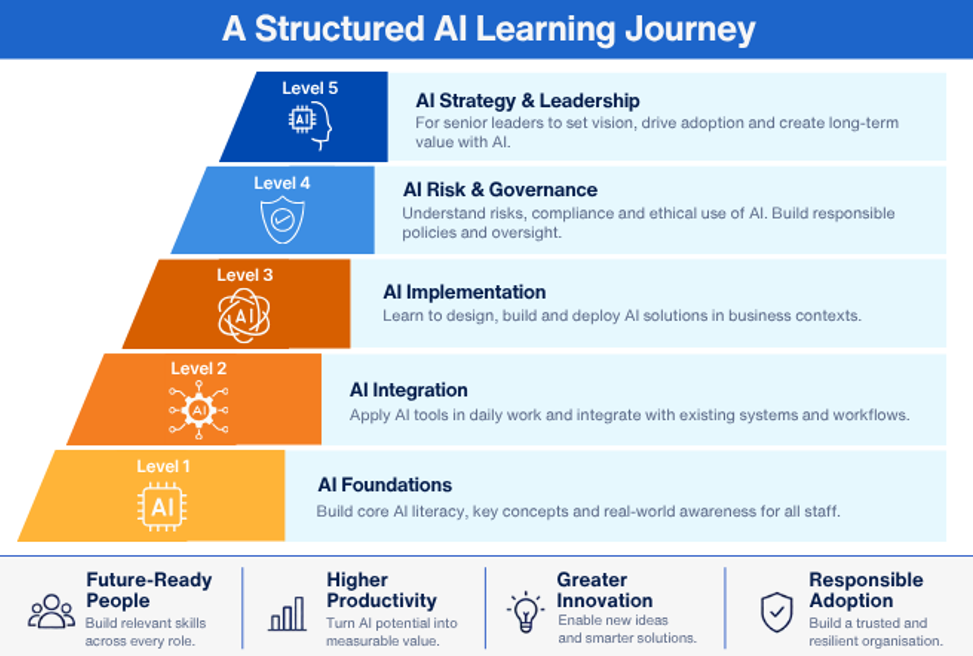
Level 1: AI Foundations | ||
Who attends • All corporate staff • Frontline employees • New joiners | Skills developed • How generative AI works • Responsible AI and data privacy • Basic prompting for daily tasks | Outcomes & Courses • Full-workforce AI literacy • Reduced resistance to AI tools • AI-3025 Work Smarter with AI • CompTIA AI Prompting Essentials • CompTIA AI Essentials |
Level 2: AI Integration | ||
Who attends • Department leads • Operations staff • Team champions | Skills developed • Incorporating AI into team workflows • Advanced prompting & task automation • Evaluating AI output quality | Outcomes & Courses • Measurable productivity gains • Department-level AI playbooks • MS-4017 Manage and Extend Microsoft 365 Copilot • CompTIA AI Prompting Essentials • CompTIA AI Prompting Essentials |
Level 3: AI Implementation | ||
Who attends • IT professionals • Digital transformation leads • HR and L&D teams | Skills developed • AI deployment and configuration • Data governance and security • AI project planning and change management | Outcomes & Courses • Secure AI deployment across teams • Internal AI champions programme launched • AI-900 Microsoft Azure AI Fundamentals • MS-4017 Manage and Extend Microsoft 365 Copilot • AI-900 Microsoft Azure AI Fundamentals |
Level 4: AI Risk & Governance | ||
Who attends • Compliance and risk officers • Legal and audit teams • Senior HR leaders | Skills developed • Enterprise AI risk frameworks • Regulatory compliance and AI ethics • Vendor evaluation and due diligence | Outcomes & Courses • AI governance policy published • Regulatory risk profile mitigated • AI-900 Microsoft Azure AI Fundamentals • Customised Corporate AI Training Programme • CompTIA Security+ or EC-Council CEH, where relevant |
Level 5: AI Strategy & Leadership | ||
Who attends | Skills developed | Outcomes & Learning Pathway |
4. Sequencing: Start at Level 5, Scale From Level 1
Before AI training is scaled across the workforce, three foundations should be in place. Senior leaders need enough AI understanding to set direction and explain the purpose. Employees need practical guidance on data security, privacy and acceptable use. Each business unit should also have someone who can encourage adoption and help colleagues apply what they learn.
Once these foundations are in place, training can expand from Level 1 across the organisation. Employees are then learning within a clear business context, with visible leadership support and practical guidance for applying AI at work.
5. Six-Month AI Workforce Rollout Plan
For HR and learning leaders who need a practical starting point, the plan below begins with leadership alignment and gradually extends capability across the workforce.
Phase | Timing | Priority Audience | Training Focus | Expected Outcome |
Phase 1 | Month 1 to 2 | C-Suite & Dept Heads | Customised Corporate AI Strategy and Leadership workshop | Leadership AI literacy; sponsorship secured |
Phase 2 | Month 2 to 3 | HR, Compliance & Risk | Responsible AI and governance, CompTIA AI Essentials | AI policy framework and governance charter drafted |
Phase 3 | Month 3 to 4 | IT & Digital Teams | AI-900, MS-4017 and relevant cybersecurity training | Secure AI deployment protocols in place |
Phase 4 | Month 4 to 5 | All Department Staff | AI-3025 Work Smarter with AI, CompTIA AI Prompting Essentials | Day-to-day AI productivity adoption across teams |
Phase 5 | Month 5 to 6 | All Levels (Review) | Role specific AI skills refresher and customised team workshops | Workforce AI Readiness Ladder assessment completed |
6. Singapore 2026: Corporate Support Available
Singapore is strengthening support for AI fluency, workforce transformation and job redesign. The initiatives below give organisations useful reference points when planning their own capability development.
SkillsFuture AI Readiness Support
SkillsFuture Singapore announced an AI readiness self diagnostic tool for the MySkillsFuture portal in 2026. It is intended to help individuals understand their readiness and identify relevant training needs. SSG also said it would work with industry partners to improve AI awareness, solution adoption and training among SMEs.
SkillsFuture Workforce Development Grant (Job Redesign+)
The Workforce Development Grant supports workforce transformation through consultancy, capability building and workforce technology solutions. Organisations should review current eligibility and funding requirements before planning their programme.
National AI Impact Programme
Under the National AI Impact Programme, IMDA is expanding AI fluency efforts for technical and non technical workers. This national direction recognises that AI capability needs to extend beyond specialists and into everyday business roles.
AIxTech and TechSkills Accelerator
IMDA and AI Singapore launched AIxTech to deepen responsible and technical AI skills across the software engineering lifecycle. IMDA also announced plans to expand TechSkills Accelerator efforts as AI reshapes technical roles.
AI Bilingual Workforce Development
Singapore's workforce strategy includes building AI bilingual capability among non technical professionals. For employers, this reinforces the need to combine domain knowledge with practical AI fluency rather than treating AI as a specialist skill alone.
The Competitive Advantage Is Capability, Not Software
AI tools are becoming more accessible across Singapore workplaces. The more important question is whether employees can use them effectively, responsibly and in ways that support business goals. Readiness comes from deliberate capability building, not access to software alone.
Organisations that build capability with purpose, beginning with leadership and extending across the workforce, will be better placed to turn AI investment into practical and sustainable value.
Explore ITEL's AI and digital learning options or speak with our team about a customised corporate AI training pathway for your organisation.
ITEL Course Reference: AI Workforce Readiness Ladder
Course | Target Audience | Readiness Level | AI Focus Area |
All employees and managers | Level 1 to 2 | AI literacy, workplace applications and responsible use | |
Business users and team champions | Level 1 to 2 | Prompting, output evaluation and workflow integration | |
Microsoft 365 users | Level 1 to 2 | Everyday productivity with Microsoft Copilot | |
IT, digital and business professionals | Level 2 to 3 | Microsoft Azure AI concepts and services | |
MS-4017 Manage and Extend Microsoft 365 Copilot | Microsoft 365 administrators and technical teams | Level 3 to 4 | Copilot administration, security, compliance and extensibility |
Cybersecurity, IT and risk professionals | Level 3 to 4 | Security foundations and AI related cyber risk, where relevant | |
Senior leaders and cross functional leadership teams | Level 5 | AI strategy, governance, workforce readiness and organisational adoption |
AI Workforce Readiness Checklist for HR Leaders
Use this checklist to assess your organisation's current AI readiness and identify priority areas for your 2026 L&D investment.
Section 1: Leadership & Governance | |
☐ | Senior leaders (C suite executives and department heads) have completed at least one AI literacy or strategy programme |
☐ | An organisational AI use policy has been drafted, approved, and communicated to all staff |
☐ | AI governance ownership is assigned (for example, an accountable leader, steering group or risk committee) |
☐ | AI risk categories (data privacy, hallucination, vendor lock-in) have been formally assessed |
☐ | AI is included as a standing agenda item at board or leadership team level |
Section 2: Workforce Skills Baseline | |
☐ | A skills baseline assessment has been conducted to identify current AI literacy levels by role |
☐ | Training needs analysis covers AI, data literacy, and prompt engineering competencies |
☐ | Employees have access to at least one approved AI productivity tool (Copilot, ChatGPT, or equivalent) |
☐ | Role-specific AI use cases have been identified for at least three core business functions |
☐ | AI training is included in the current financial year L&D plan with allocated budget |
Section 3: Programme Design & Sequencing | |
☐ | Leadership alignment and governance are established before workforce training is scaled |
☐ | AI training is tied to specific business outcomes (not just attendance metrics) |
☐ | At least one internal AI champion has been identified and trained per department |
☐ | A six-month training rollout plan has been developed and approved by HR leadership |
☐ | Course selection maps to each role, use case and capability gap |
Section 4: Technology & Infrastructure | |
☐ | AI tool deployment is coordinated with IT security and data governance teams |
☐ | Employees have received data handling guidance specific to AI tool usage |
☐ | A data classification policy exists that covers AI-generated content and prompts |
☐ | AI tool licencing covers all relevant staff (not just selected departments) |
☐ | An AI incident reporting process has been established and communicated |
Section 5: Measurement & Continuous Development | |
☐ | AI adoption metrics are tracked at department level (usage rates, productivity outcomes) |
☐ | Post-training assessments confirm skill transfer, not just course completion |
☐ | AI training ROI has been calculated or is planned for measurement within 90 days of rollout |
☐ | A refresher training schedule is in place to address evolving AI tools and regulations |
☐ | The AI Workforce Readiness Ladder level has been assigned to each business unit |
Score: 20 to 25 ticks = strong AI readiness. 10 to 19 = capability gap requiring structured action. Under 10 = AI workforce readiness should be an immediate strategic priority.
References
Infocomm Media Development Authority. (2025). Singapore to Build AI-Fluent Workforce to Accelerate National AI Ambition.
SkillsFuture Singapore. (2026). Committee of Supply 2026: Enhancement of Support for AI Upskilling and Workforce Development Grant Enhancements.
Infocomm Media Development Authority. (2026). Major Push to Upskill Tech Professionals and Grow the Next Generation of Tech Leaders.
To learn more about the IT industry, contact us today.
Contact usGet the latest news and insights and stay up-to-date with ITEL
Recent articles
The AI Skills Gap in Singapore’s Financial Services: Why Technology Investment Alone Is Not Enough
Financial services organisations are investing in AI to improve productivity, accelerate information processing and support better decision-making. However, technology investment alone does not guarantee successful adoption.
Read ArticleBeyond Automation: Why Workforce Capability is the Real Engine of Singapore's AI-Powered Logistics Boom
Explore how Singapore’s logistics industry is adopting AI and automation, and how workforce upskilling in AI, Power BI and workflow automation can drive smarter supply chains.
Read ArticleAIHGle 2.0 Singapore: What Healthcare Providers Need to Do Now
AIHGle 2.0 requires healthcare providers to strengthen AI governance, protect patient data, ensure human oversight, and build workforce capabilities for responsible, safe AI adoption.
Read Article