Cybersecurity Courses in Singapore: From First Certification to Security Leadership
Build job-ready security skills with ITEL’s cybersecurity courses in Singapore. Choose from 13 courses, from CompTIA Security+ for newcomers to ethical hacking, penetration testing, digital forensics and CISO-level leadership. Many courses are SkillsFuture funded, so eligible Singaporeans pay as little as 10% of the course fee.
13 cybersecurity courses across 3 levels
Up to 90% SkillsFuture funding
Training for CompTIA, EC-Council and Microsoft certifications
Every course below maps to an industry certification. Courses marked (SF) are eligible for SkillsFuture funding. Filter by level to find the right starting point.
Beginner
CompTIA Security+ (SF)
40 hours · Classroom · SkillsFuture funded
Your first step into cybersecurity. Learn how threat actors operate, then put core defences in place: cryptography and PKI, identity and access management, secure network design, cloud security and incident response. Prepares you for the globally recognised CompTIA Security+ certification.
Most security tools and servers run on Linux. Learn to manage users, permissions, storage and networking, harden systems with SELinux/AppArmor and firewalls, and automate tasks with Bash scripting. Prepares you for CompTIA Linux+.
Learn to think like an attacker so you can defend like one. Covers reconnaissance, scanning, system hacking, malware, web application and wireless attacks, IoT/OT and cloud, plus AI-driven ethical hacking tools. Prepares you for EC-Council’s CEH certification.
Learn to detect, contain and recover from security incidents, from network and denial-of-service attacks to malicious code and insider threats. Covers risk assessment, building an incident response plan and CSIRT, forensic evidence handling, incident reporting and the laws that govern incident response. Prepares you for EC-Council’s E|CIH certification.
EC-Council’s Certified Network Defender (CND) programme for IT and systems administrators. Secure network perimeters and endpoints, protect cloud, virtual and wireless environments, monitor traffic and logs, and respond to incidents.
Prepares you for EC-Council’s Computer Hacking Forensic Investigator (CHFI) certification. Learn evidence acquisition and anti-forensics, Windows, Linux and Mac forensics, and how to investigate network, web, cloud, dark web, email and malware incidents.
Master the threat intelligence lifecycle: planning, data collection from multiple feeds, analysis of malware and indicators of compromise, and writing intelligence reports that decision-makers can act on. Prepares you for EC-Council’s C|TIA certification.
Hands-on training in configuring and managing Fortinet FortiGate firewalls on FortiOS 7.2, including firewall policies, VPNs, security profiles, logging and monitoring.
Based on EC-Council’s Certified Penetration Testing Professional (CPENT) curriculum and designed for practitioners with a networking and security foundation. Plan and run full penetration tests across networks, web applications (OWASP Top 10), wireless, IoT, OT/SCADA and cloud, then finish with binary exploitation and professional report writing.
SC-900: Microsoft Security, Compliance, and Identity Fundamentals (Synchronous e-learning)
7 hours · Live online
A one-day introduction to Microsoft’s security, compliance and identity services. Ideal for Microsoft 365 and Azure users who want a recognised starting point. Prepares you for the SC-900 exam.
Build the skills of a security operations centre (SOC) analyst: threat detection, behavioural analytics, vulnerability management and incident response. Prepares you for CompTIA CySA+.
For intermediate to advanced professionals. Covers all eight domains of the CISSP Common Body of Knowledge, from security and risk management and security architecture to identity and access management, security operations and software development security.
For senior practitioners moving into CISO-level roles. Learn security governance, audit and compliance management, cyber defence management, risk strategy, and the financial and procurement planning behind a security programme.
Which Cybersecurity Certification Should You Take?
The right cybersecurity certification in Singapore depends on where you are today and the role you want next. These pathways show how ITEL courses build on each other.
Cybersecurity career pathways and suggested ITEL courses
If you are / want to be…
Suggested path
New to cybersecurity, or in IT support → SOC analyst → threat intelligence analyst
Microsoft 365 or Azure administrator adding security
SC-900 → a Microsoft role-based security course matched to your job: SC-300 (identity and access), SC-401 (information protection) or SC-200 (security operations), available on request. Add CompTIA Security+ (SF) for vendor-neutral foundations
IT manager or senior practitioner → security leadership
Professionals from audit, risk, project management and operations already bring judgement that security teams need. Start with CompTIA Security+ (SF) to build the technical base. If you are a Singapore Citizen aged 40 or above, the SkillsFuture Mid-Career Enhanced Subsidy can cover up to 90% of the course fee.
SkillsFuture Funding for Cybersecurity Courses
As an SSG-approved training provider, ITEL offers SkillsFuture funding on all courses marked (SF).
Funding eligibility for cybersecurity courses
Who
Funding
Applies to
Singapore Citizens and PRs aged 21 and above
Up to 70% course fee funding
Courses marked (SF)
Singapore Citizens aged 40 and above
Up to 90% (SkillsFuture Mid-Career Enhanced Subsidy)
Courses marked (SF)
NTUC members
UTAP: 50% of the unfunded fee, up to $250 a year (under 40) or $500 a year (40 and above)
Funding rates vary by course funding category. GST is payable on the full course fee. Use the funding calculator on each course page for your estimated fee; final eligibility is confirmed at enrolment.
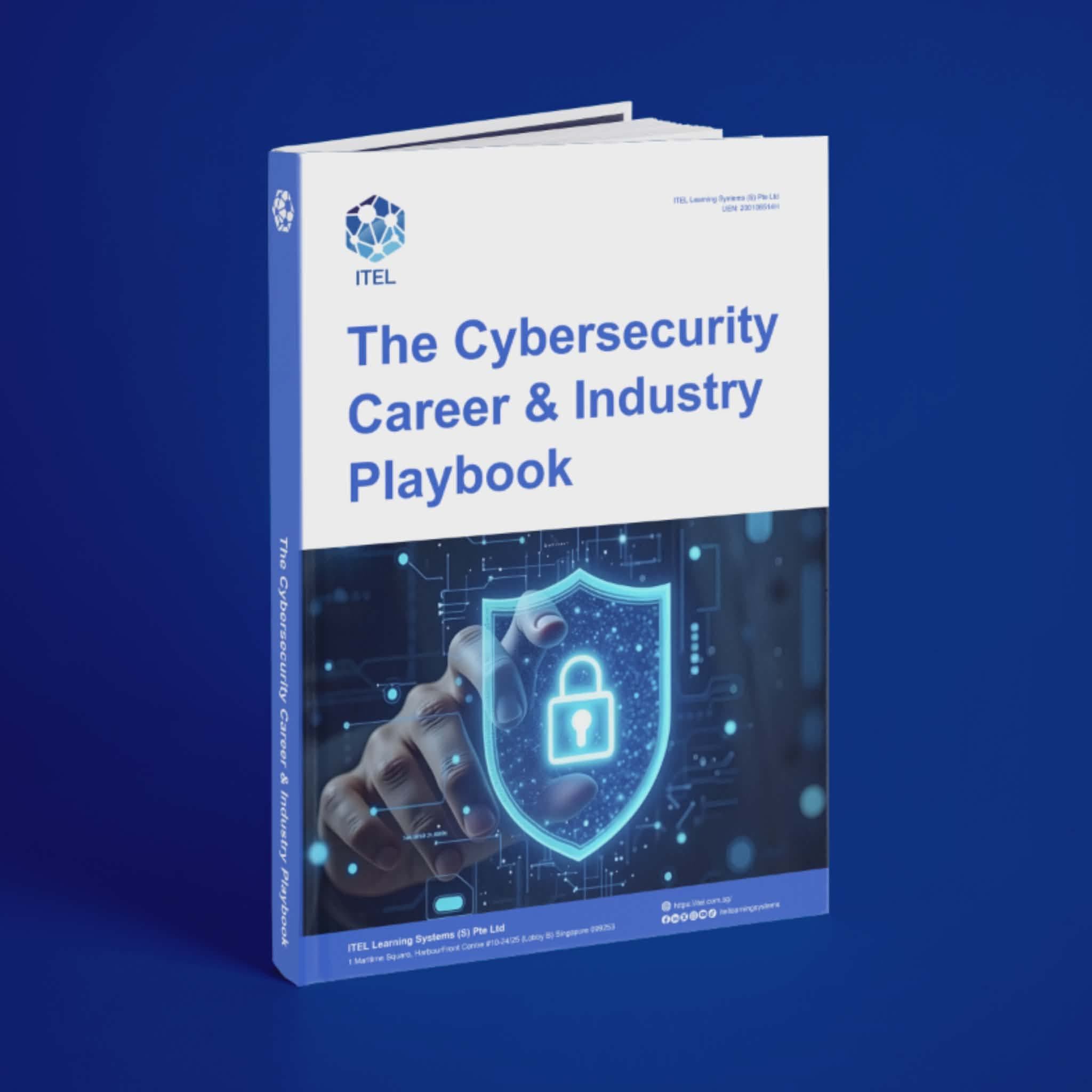
Free Download: The Cybersecurity Career & Industry Playbook
A practical guide to Singapore’s cybersecurity job market, certification roadmaps and the skills employers are hiring for. Use it to plan your next move before you enrol.
ITEL has trained IT and security teams at organisations such as ABB, Medtronic, TotalEnergies and Yokogawa. We can help you plan certification pathways for your team and make the most of company-sponsored funding.
Cybersecurity Courses in Singapore: Frequently Asked Questions
What are the best cybersecurity courses in Singapore for beginners?
Start with CompTIA Security+ (SF). It covers the core of cybersecurity, including threats, cryptography, identity management, secure networks and incident response, and is eligible for SkillsFuture funding. If you will be working with servers or security tools, CompTIA Linux+ adds the Linux skills most security work relies on.
Do I need IT experience to take a cybersecurity course?
Not for the beginner courses, though basic familiarity with computers and networks helps. Professional and expert courses such as Security Analysis and Penetration Testing (SF) and Information Systems Security (SF) assume a working foundation in networking and security. Some certifications also have experience requirements; CISSP, for example, requires relevant work experience before you can be fully certified. Our course consultants can check which course fits your background.
How much SkillsFuture funding can I get for cybersecurity courses?
Singapore Citizens and PRs aged 21 and above can receive up to 70% course fee funding on courses marked (SF). Singapore Citizens aged 40 and above can receive up to 90% under the SkillsFuture Mid-Career Enhanced Subsidy. NTUC members can also claim UTAP on eligible courses. Each course page has a funding calculator that shows your estimated fee.
Which cybersecurity certification should I get in Singapore?
Are the cybersecurity classes in person or online?
Most courses run in a physical classroom at ITEL, 111 Somerset Road. CompTIA CySA+, SC-900 and FortiGate 7.2 Security are delivered live online via Zoom or Microsoft Teams. Selected courses offer weekday-morning or evening schedules.
How long do the cybersecurity courses take?
Courses range from 7 hours (SC-900, a single day) to around 42 hours (CEH). Most SkillsFuture-funded courses are about 40 hours. Check each course page for the current intake dates and class schedule.
What does Guaranteed-to-Run (GTR) mean?
A class marked Guaranteed-to-Run will go ahead on its scheduled dates, so you can book leave and plan around it with confidence.
Can ITEL train our company’s IT or security team?
Yes. ITEL delivers cybersecurity training for corporate clients across healthcare, manufacturing, energy and finance. Contact us to discuss group enrolment and funding for company-sponsored learners.
Not Sure Where to Start?
Tell us your background and goals. Our course consultants will recommend the right cybersecurity course and check your funding eligibility.